Nicholas Dames
All the Write Stuff
Along time ago, in the far-off 1990s, a mentor warned me that the subject I’d proposed to study, the Victorian novel, was fast approaching its expiration date. Soon enough, he said, its eye-straining bulk would set behind the horizon of cultural memory, following its 18th-century predecessors into antiquarian darkness. It was partly a numbers game, he explained: when the odometer clicked over and the 20th century squatted between the Victorians and us, they would become the-thing-before-the-thing-before, distant and inscrutable. Likewise, not so very long afterwards, the novel itself would probably go, as the elaborate economic and technological apparatus that had kept it going – the printed book, high levels of mass literacy, the not-yet-wholly-captured leisure time of industrial and post-industrial life – would come apart.
It was a whole fin-de-siècle mood, that little speech, blithely helpless about going down the long slide. I resisted it. Did we not still live in a class-stratified but socially mobile, uneasily secularised, urbanised and financialised modernity, the very world Victorian novelists described? Was Mr Micawber going to stop being, among other things, so painfully funny; would throttled dreamers like Dorothea Brooke ever feel entirely unreal; would Lucy Snowe’s self-harming rage or Isabel Archer’s sucker’s bet on unconventional happiness not stir uncomfortable recognition?
Hard, now, to feel the same confident scepticism. Build a life around the novel and you can’t help but feel the ground swell and pitch under your feet. What do you do to resist a prophecy that seems less unreal by the day? Maybe you indulge, however melancholically, in a bit of monument-building. It’s not hard to see the melancholy in Philip Hensher’s A History of the Novel in Britain. It ends with a symptomatically elegiac afterword, in which Hensher describes the cheap 1930s reprint editions of Dickens he inherited from his grandmother (the person-before-the-person-before-us), the brittle pages of David Copperfield falling apart from overuse. Hard not to feel the presence of the woman, like David himself, reading as if for dear life. But monument, here, ends up wonderfully triumphing over melancholy.
For monument this is: a great slab of a book, running to almost 600 pages of prose and another fifty more of bibliography, with ambition and sweep to match, attempting a comprehensive and coherent narrative history of the British novel from the Copyright Act 1710 to Zadie Smith’s White Teeth, published just weeks into our century. For all its heft, it is immersive; massive, but fleet. The epic labour behind it – Hensher insists in its introduction that he has only written about novels he’s actually read, the number of which, judging from the bibliography, is surely well over a thousand, from the familiar to the obscure – is nonetheless carried off buoyantly, as if it were (mostly) a joyous ride. Whatever longueurs there must have been, still, one feels: what larks!
This is, of course, openly and even defiantly, a novelist’s account of the novel’s history. Where it does not ignore familiar abstractions, it refuses them. About ‘realism’, the term that has vexed scholarship the way ‘consubstantiality’ troubled early ecumenical councils, Hensher is silent; about ‘modernism’, where he isn’t sceptical about its utility he refutes its distinctiveness. Instead there is really only one general term that matters, The Novel, object of an almost jealous affection. Even here specificity reigns: the book speaks more of novels than The Novel, preferring the particular over the general. Its narrative resembles a bildungsroman, The Novel liberating itself from patronage, de facto censorship, narrow audiences and low esteem in the hierarchy of literary art; its rhythm, weaving between summary and scene, between discussions of the legal and material conditions of publishing and evaluations of particular oeuvres, has an almost Victorian feel: unhurried, but engrossing.
Its heart remains, however, with individual instances – moments, not plot, which Hensher handles with a connoisseur’s relish and a proselytiser’s enthusiasm, but most of all a professional’s discernment, one that issues in sharp disapproval, or a gentle dampening of unwarranted opinion. Gothic novelists are, ‘on the whole, painfully inept’; Ann Radcliffe is a ‘terrible writer’ and Matthew Lewis’s The Monk ‘a work of inconceivable vulgarity’. Gissing’s novels suffer from their ‘mechanical monotony of handling’, Huxley’s ‘acquired a reputation for cleverness because they appear to be about clever people’ and Ford Madox Ford’s The Good Soldier is dismissed as ‘a superficially heartbreaking story’. It isn’t all indictment, as much fun as that can be; there is also the pleasure of seeing unexpected names lavished with praise, such as, among others, Richard Jefferies, David Storey, Robert Surtees, Charlotte Yonge. But the fun is there either way, and it tends to reside in the critic’s best weapon, the startling apposition. As in ‘Oscar Wilde’s The Picture of Dorian Gray (1890), a work of lamentable feebleness in everything but its compelling premise’; or ‘Angus Wilson, an outrageous purveyor of ludicrous bad-taste comedies’.
If you’re a reader with a generalising turn of mind, however, you might notice some aesthetic principles emerging. You might discern a preference for the novel as a craft, a series of flexible and ingenious adjustments to long-standing practice, rather than as theoretical experiments. You will detect the importance of dialogue – dialogue being, perhaps fortuitously for Hensher, one of the least theorised aspects of fictional practice; at any rate, it matters here more than description or narratorial observation. (You will perhaps enjoy his assertion, in a footnote, that Henry Green was a novelist ‘whose main motivation in writing a novel was to inflict paragraphs about fields upon the reader’.) You’ll absorb his dislike of genre fiction, particularly historical fiction, unless the genre in question is sublated out of its rigidities, as with le Carré or, in a more eccentric way, Tolkien. (Whisper it, but might Hensher’s preferred modes, such as the condition-of-England tradition to which his own novels belong, be themselves genres?) You’ll note his insistence on the national frame, and the silences and exclusions that work to keep it intact. (‘What of The Novel’s cosmopolitanism?’ you might want to insist, provoked into generality.) And you’ll observe his preference for a richly textured, attentive-to-particulars prose, for styles stippled by the sound of actual human speech.
More broadly still, where the glare of canonicity has settled over a figure, Hensher can seem measured, perhaps even a bit captious. His impulse is to see what the spotlight has left in the shadows. Jane Austen’s novels, we’re reminded, ‘have swelled in the collective consciousness to block out much of the activity of Austen’s contemporaries’, including Elizabeth Inchbald, about whom his praise is less qualified. Often it is as subtle as the slightest withholding of attention, a shade or two of reserve: one might notice how comparatively briskly Virginia Woolf is treated, at least in relation to her current stature. Thackeray receives almost equal attention to those contemporaries – Dickens, Eliot, the Brontës – who’ve fared far better with the mechanisms (reprint editions, film treatments, academic canonisation) of posthumous reputation. About Wodehouse, not Lawrence or Woolf, Hensher asks in a puckishly rhetorical mode whether his novels of the 1920s and 30s might ‘actually represent the most lasting success of literary modernism’. The unjustly unread or unsanctified weighs heavier in the scales than the ritually celebrated; to have had official enshrinement, through prizes or high-cultural canonisation, arouses Hensher’s suspicion. Whether this feels contrarian or astute and free-minded will depend on one’s preference for a small gathering of Greats or a much larger crowd of the Accomplished – will depend perhaps above all on whether one subscribes to the history of taste as a gradual refinement and sloughing off of error, or as the descent of an unjust obscurity, as, let’s say, a catastrophe piling wreckage at our feet.
But that last phrase gives me away. I must now come to the book’s decided, even organising animus against academic taste. Reader, I noticed it. If like me you come to the book from an ‘academic background’, you might feel as if you’ve stumbled into a party whose purpose is to exclude People Like You. Protest however you like, cry out ‘but I love The Novel too, even, yes, novels!’ – you will not escape the sense that you are not wanted. Here you are instead one of the ‘non-practitioner specialists’ who cannot see outside the boundaries of their over-tilled fields, and whose concentration on a small set of canonical texts has belied the diversity of the inheritance they might have been supposed to treasure. A point is well scored. The multi-authored handbook history that is Hensher’s target does tend to suffer from too much mannered reticence, a lack of the crunch and spice of trained judgement; the constraints of the syllabus produce a mental habit in which the many are generally sacrificed for a familiar few. And worse yet, Hensher argues that the academic reader privileges ‘subject matter’, the book’s most prominent bugbear, over the skills and varieties of ‘handling’, dull savoir over artistic saveur.
As one of the uninvited, I want to say, placatingly but insistently: might we learn from each other? (Hensher’s afterword calls for a Library of the Novel in Britain reprint series to preserve vanished worthies, which perhaps is where that exchange could happen.) Might the theory of the novel – abstruse as it can be – have something to say about the difficulty of disentangling ‘subject matter’ from ‘handling’, a distinction that in Hensher’s History sometimes feels more happenstance than transparent? When he argues, convincingly, that George Eliot’s ‘large subject is, perhaps, thwarted lives’; or when, apropos the neglected Andrew Salkey, he discusses the lineage of boarding-house fiction; or when he describes the new social formations, from industrial Manchester to the worlds of sexual dissidence, that novelists set out to map – are these kinds of about-ness not both subject and technique? More, could theory, in its bolder abstractions, more convincingly describe the British novel as a local – and peculiar – instance of a broad historical development, in which the conventions of medieval romance torqued under the pressure of the rising of various European middle classes? Might it be asked, in the way scholars often have, why the novel has always been so intellectually assimilative, taking on gems and junk alike from its aesthetic rivals, epic and drama and film, and from fields well outside the aesthetic?
Call these questions towards a rapprochement. Preserving what can seem now like an endangered form is an anxiety for both the practitioner and the non-practitioner specialist alike. Perhaps the best way to do it is, as Philip Hensher has done here, to keep talking of what one loves. As Henry James put it, there is really too much to say.
Sign Up to our newsletter
Receive free articles, highlights from the archive, news, details of prizes, and much more.@Lit_Review
Follow Literary Review on Twitter
Twitter Feed
Philip Hensher
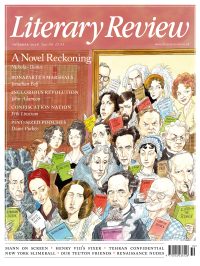
@PhilipHensher ·I'm on the cover of the @Lit_Review in a drawing by the great @chrisriddell50 ! Excellent review by Nicholas Dames. https://literaryreview.co.uk/all-the-write-stuff
Literary Review
@Lit_Review ·Eric Hobsbawm’s autobiography was published in 2002; his widow’s memoir came out in 2019, as did the first biography of the historian. Is there anything left to say?
Richard Vinen weighs in.
Richard Vinen - Grand Bourgeois
Richard Vinen: Grand Bourgeois - The Age of Hobsbawm: The Life of a Revolutionary Historian by Emile Chabal
literaryreview.co.uk