
May 2024, Issue 529 Antony Spawforth on Cleopatra * Margaret Reynolds on ancient women * Dennis Duncan on jigsaws * Miranda Seymour on early feminists * Rosamund Bartlett on Wassily Kandinsky * Georgina Adam on art world fraud * Daisy Syme-Taylor on ancient poetry * Richard Vinen on labour’s lefties * Richard Davenport-Hines on queer London * Felicity Brown on Shakespeare and war * Morten Høi Jensen on Franz Kafka * Fergus Butler-Gallie on Salman Rushdie * Andrew Martin on Paris * Carl Miller on AI * James Le Fanu on diet pill dangers * Zoe Guttenplan on musical Dickens * Stevie Davies on Claire Messud * David Anderson on Hari Kunzru * Rhodri Lewis on Shakespearian fiction * Ed Cumming on Kaliane Bradley * and much, much more…
The Current Issue
Margaret Reynolds
The Face That Felled a Tyrant King
From Chaucer’s Wife of Bath to Jane Austen’s Anne Elliot, women have known that men tell their own stories. As Anne (or Austen) puts it, ‘the pen has been in their hands’. But very often, men are also the ones who come to tell the stories that, strictly, belong to women. In The Missing Thread, Daisy Dunn tries to address this problem with respect to the women of classical antiquity. To be sure, she knows that a modern-day historian is still forced to rely on older, prejudicial narratives. Here is the Central Asian ruler Tomyris in around 530 BC speaking out against the advance on her kingdom by – and the marital advances of – Cyrus II of Persia: ‘King of the Medes, stop striving after what you’re striving after... read more
More Articles from this Issue
Antony Spawforth
The Cleopatras: The Forgotten Queens of Egypt
By Lloyd Llewellyn-Jones
In 1983, the BBC broadcast an eight-part dramatisation called The Cleopatras. I dimly remember the actor Richard Griffiths commanding the small screen as a shaven-headed Ptolemy VIII (‘Potbelly’). The series posed as a palace drama akin to the BBC’s earlier I, Claudius. Despite focusing, like that series, on what has been labelled ‘a tribe of fairly repellent people’, it did not meet with the same critical acclaim and has not been reshown. If it were, muses the website televisionheaven.co.uk, would today’s... read more
Felicity Brown
Once More unto the Bard
Oleksii Hnatkovskyi stands alone as Hamlet, spotlit and swathed in blue and yellow. The scene is from a Ukrainian-language production of Hamlet, directed by Rostyslav Derzypilskyi, performed in the basement-turned-shelter of the Ivan Franko Theatre in Kyiv on the sixteenth day after Russia’s invasion. One week earlier, in his address to the British Parliament, Ukraine’s president Volodymyr Zelensky had paraphrased Hamlet to sum up the existential threat faced by his people. ‘The question for us now’, he said, ‘is to be or not to be.’ There is no end to war... read more
Andrew Martin
Impossible City: Paris in the Twenty-First Century
By Simon Kuper
Those of us who romanticise France are familiar with books in which a British person attempts to ‘live the dream’ there. They’re essentially travel books, evocations of sunsets and cosy bistros offset with the social comedy of dealing with the less cosy French. Impossible City is almost that sort of book, but perhaps a bit more like a portrait of Parisian society with autobiographical elements. The style is elegant and flinty, the humour dry. Kuper quotes his wife’s response to gaining French nationality: ‘I was hoping I’d become... read more
Dennis Duncan
The W Factor
Rain is general all over Cornwall. I am in St Ives, on holiday with my family. Outside may be miserable, but inside we have a jigsaw. I think of ‘Pangur Bán’, the ninth-century Irish poem about a clerk and his cat both at work, one writing and the other mousing, the contentment of companied exertion. ‘Day and night, my own hard work/Solves the cruxes,’ the poet wrote, in Heaney’s translation. Three generations – children, grandparents, siblings – come and go, criss-crossing and reconstellating at the puzzle table, an hour here... read more
Richard Davenport-Hines
Some Men in London: Queer Life, 1945–1959
By Peter Parker (ed)
The Diaries of Mr Lucas: Notes from a Lost Gay Life
By Hugo Greenhalgh
Two cognate books depict London’s gay scene in the years before the partial decriminalisation of male homosexuality in England and Wales. Peter Parker paints a wide historical canvas while Hugo Greenhalgh is a miniaturist. Both books have a provocative and mordant humour. Yet even when they celebrate irrepressible spirits, they dismay... read more
Miranda Seymour
Bluestockings: The First Women’s Movement
By Susannah Gibson
To be a ‘bluestocking’ is nowadays considered the pits. Yet in their heyday, the second half of the 18th century, the original bluestockings were respected and even admired. The trashing of this lively, intelligent, spirited group of women began in around 1800. It culminated in Thomas Rowlandson’s 1815 caricature of a group of harridans tearing each other’s hair out and clothes off over – connecting them to dangerously radical politics – a puddle of French cream. The Victorians... read more
Most Read
moreFelicity Brown
Shakespeare and War
Shakespeare at War: A Material History
By Amy Lidster & Sonia Massai (edd)
Antony Spawforth
The Cleopatras: The Forgotten Queens of Egypt
By Lloyd Llewellyn-Jones
Richard Davenport-Hines
Some Men in London: Queer Life, 1945–1959
By Peter Parker (ed)
The Diaries of Mr Lucas: Notes from a Lost Gay Life
By Hugo Greenhalgh
Jonathan Boff
The Eastern Front: A History of the First World War
By Nick Lloyd
Margaret Reynolds
The Missing Thread: A New History of the Ancient World Through the Women Who Shaped It
By Daisy Dunn
From the Archives
moreFrom the March 2020 issue
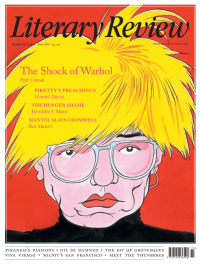
Peter Conrad
Warhol: A Life as Art
By Blake Gopnik
From the June 1999 issue
Christopher Hitchens
Some Times in America
By Alexander Chancellor
From the June 1989 issue
Hilary Mantel
What am I Doing Here
By Bruce Chatwin

Back Issues
more
April 2024
March 2024
Sign Up to our newsletter
Receive free articles, highlights from the archive, news, details of prizes, and much more.@Lit_Review
Follow Literary Review on Twitter
Twitter Feed
Don't ask about the dress code, don't talk about your spouse too much, flirt with everyone
Andrew Martin on the rules, pleasures and pitfalls of living in Paris
Andrew Martin - Bobos versus Beaufs
Andrew Martin: Bobos versus Beaufs - Impossible City: Paris in the Twenty-First Century by Simon Kuper
literaryreview.co.uk
for the latest edition of @Lit_Review I worked on some excellent pieces – @MortenHoiJensen on Kafka
@ellafox_m on @mimpathy (Honor Levy)
@profrhodrilewis on Shakespeare novels
@edcumming on Kaliane Bradley
@zoeguttenplan on @NationalTheatre's Dickens show
wrote about MY FIRST BOOK (@GrantaBooks) for @Lit_Review, a book that I think makes difficult things look very easy: