Piers Brendon
Plum Assignments
Jan Morris: A Life
By Sara Wheeler
Faber & Faber 432pp £25
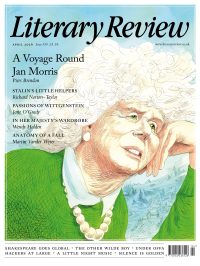
The subject of this excellent biography wished to be remembered as Jan ‘Empire’ Morris, author of the great imperial trilogy Pax Britannica, but she correctly predicted that the valedictory headlines would read ‘Sex Change Author Dies’. As James Morris, he had won early fame as the Times reporter who broke the news of the conquest of Everest on Coronation Day, 1953. And Morris’s real distinction, as Sara Wheeler affirms, was as a travel writer. It was a term she loathed. (Wheeler follows Morris’s own lead in using male pronouns for the author’s early life and female ones after 1970, when transition was nearing completion.) But as a young man James had immersed himself in Charles Doughty’s Travels in Arabia Deserta and Alexander Kinglake’s Eothen, and went on to evoke the character of places far and near in vivid prose, turning each odyssey into a personal adventure. Sometimes, it is true, Morris indulged in narcissism and euphuism: slam shut his book about Oxford, said Dennis Potter, and ‘the purple ought to ooze out like the juice of squashed plums’. Yet Morris was, Wheeler plausibly maintains, ‘among the finest descriptive writers who ever lived’.
Born in 1926, James grew up in Clevedon on the Bristol Channel. Here he spied ships with a telescope (the luxury item later requested on Desert Island Discs) and viewed the distant mountains of Wales. These gave him ‘my very first intimations of hiraeth’ – the longing for home, which eventually mutated into fierce Welsh nationalism. His father, a mechanic whom James elevated into an engineer, died young; but his capable, musical mother pushed her children on to win scholarships. James went to Lancing College, where he engaged in the usual homosexual fumblings and found it natural to play the girl’s role. When he joined the army in 1944 he showed no signs of effeminacy. Yet military service, which he enjoyed, acting as an intelligence officer in Egypt and Palestine, somehow confirmed his intuition that he was not as other men are. This is not to imply that James was gay and he later resisted attempts to typecast him as such. He spoke instead of his ‘mystic conviction that he was inhabiting the wrong body’.
In 1949 James married Elizabeth Tuckniss, the daughter of a Ceylon rubber planter, who bore him five children. Morris was and remained ‘perfectly bonkers’ about her, declaring that she had ‘given nobility to my mostly frivolous life’. Elizabeth’s own existence resembled that of the dutiful colonial wife, forever heeding her peripatetic husband’s injunction to ‘pay, pack and follow’. They moved house often and Morris saw himself as a human whirligig. After taking a late degree at Oxford, where he edited the student newspaper Cherwell, he got a job on The Times, which quickly sent him on foreign assignments. His dispatches livened up the venerable broadsheet, which still reserved news for the inside pages and was, as he remarked, ‘the daily tapestry of orthodoxy’. So, despite his lack of mountaineering experience, Morris was chosen to report on John Hunt’s Everest expedition. Wearing crampons for the first time, he climbed to 22,000 feet and, to confound rival journalists, sent a coded message announcing that Edmund Hillary and Tenzing Norgay had reached the summit. Among additional articles he wrote was one about the Abominable Snowman.
By now travel and writing had become for Morris not so much an occupation as an addiction. Quitting The Times, he went on ceaseless peregrinations and was ubiquitous in print, turning up wherever news was being made. He had a good nose for a scoop. In 1956 he saw Mystère warplanes on the tarmac in Cyprus and correctly reported that France was colluding with Israel in the attack on Egypt, something both sides denied. A flood of books poured from his typewriter – too many for Wheeler to cite. At their best, as in his portrayal of Venice, they were dazzling evocations of the spirit of the place, romantic, impressionistic and idiosyncratic. But the quality varied, fact was sometimes alloyed with fiction and imagination too often superseded research. Morris described the feudal tyranny of Oman as ‘a little backward paradise on the seashore’.
Journeys across lands where the Union Jack had once flown inspired Morris to create Pax Britannica, the three-volume chronicle of the British Empire, published between 1968 and 1978, which she regarded as the ‘centrepiece of my life’. It was a major literary achievement, conjuring up the spectacle of empire with narrative zest and dramatic flair. It was also an exercise in nostalgia, a rhapsody in pink. Morris focused on style rather than substance, on the colourful detail rather than the pervasive racism. As Wheeler says, the books swept ‘butchery and appropriation aside to the tune of a bugle reveille’. In Celtic mode, Morris did concede that the British Empire was a ‘dreadful phenomenon’, yet she always took pride in it as an instrument of enlightenment. My own history of the Empire she deemed ‘a tremendous work of scholarship, but a work with no heart’, because I was ‘too young to have experienced imperial emotions’ and therefore failed to glimpse ‘any beauty, even illicit beauty, in the exercise of imperial power’.
While Morris was producing his gorgeous pageant and still siring children, he prepared to change gender. Over the years between 1954 and 1972, he ingested an estimated 12,000 pills and absorbed as much as 50,000 milligrams of female matter. These gave him an androgynous look and he practised wearing women’s clothes, eventually dressing, Wheeler remarks, ‘like a Walmart version of the Queen’. In 1972, Morris had a surgical operation, performed by Dr Georges Burou in Casablanca, known as an ‘anteriorly pedicled penile skin flap inversion vaginoplasty’. The new orifice permitted intercourse and even orgasm, but it required lifelong dilation since the body treated it as a wound to be healed. Morris depicted the process more in spiritual terms, as the realisation of her own true nature, and gave a classic account of it in her aptly entitled book Conundrum (1974). Physically, the transformation was less than complete. Jan’s hands remained masculine, her voice was deep and she showed traces of five-o’clock shadow. Germaine Greer viewed her as ‘a man who has eaten a great many pills’.
Morris certainly behaved like an old-fashioned paterfamilias. Elizabeth, who stuck by her throughout and is the real heroine of the story, was still expected to perform the wife’s conventional domestic role. Towards their offspring Jan could be insensitive and sometimes cruel. The eldest, Mark, once the recipient of a fatherly warning that masturbation makes you blind, concluded that Jan was ‘a narcissist in her inability to empathise’. Henry, the second son, said of his relationship with Jan: ‘We were introduced, but we never actually got to know each other.’ And Jan made a habit of demeaning their daughter Susan. Like a crusty clubman, Morris harrumphed about spongers, taxes and the decline of family values. She avoided other transsexual people. Charm and wit barely disguised a macho egotism. On the other hand, Morris’s publishers complained that she had lost her edge and that the writing had ‘become girlie’.
Wheeler acknowledges that whimsy became a prevailing weakness well before Morris’s death in 2020. It was typified by her mawkish study of Admiral John Fisher, Fisher’s Face (1995). Yet some of the magic remained, notably in her allegory of limbo, Trieste and the Meaning of Nowhere (2001), and her fantasy about a mythical city-state, Hav (2006). It is impossible to imagine a better guide to Morris’s tricky character and nomadic career than Sara Wheeler. Herself the author of fine travel books, she writes beautifully and her literary judgements are astute. She preserves just the right blend of sympathetic engagement and critical detachment. And she does not pretend to omniscience, leaving some things up in the air, including the mystery of Morris’s motivation and whether the transition ultimately provided the fulfilment she craved. Seldom have I read such an enthralling biography.
Sign Up to our newsletter
Receive free articles, highlights from the archive, news, details of prizes, and much more.@Lit_Review
Follow Literary Review on Twitter
Twitter Feed
Literary Review
@Lit_Review ·Eric Hobsbawm’s autobiography was published in 2002; his widow’s memoir came out in 2019, as did the first biography of the historian. Is there anything left to say?
Richard Vinen weighs in.
Richard Vinen - Grand Bourgeois
Richard Vinen: Grand Bourgeois - The Age of Hobsbawm: The Life of a Revolutionary Historian by Emile Chabal
literaryreview.co.uk
Literary Review
@Lit_Review ·Eric Hobsbawm’s autobiography was published in 2002; his widow’s memoir came out in 2019, as did the first biography of the historian. Is there anything left to say?
Richard Vinen weighs in.
Richard Vinen - Grand Bourgeois
Richard Vinen: Grand Bourgeois - The Age of Hobsbawm: The Life of a Revolutionary Historian by Emile Chabal
literaryreview.co.uk
Annie Jacobsen
@AnnieJacobsen ·"Biological War: A Scenario" by Annie Jacobsen - review by Hamish de Bretton-Gordon (fmr commander of British CBRN defense forces)
Apocalypse Now
via @Lit_Review
Hamish de Bretton-Gordon - Apocalypse Now
Hamish de Bretton-Gordon: Apocalypse Now - Biological War: A Scenario by Annie Jacobsen
literaryreview.co.uk