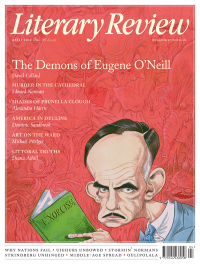
David Collard
Spinach & Ice Cream
Exorcism: A Play in One Act
By Eugene O’Neill
Yale University Press 85pp £11.99
There’s a moment to savour in the 1930 Marx Brothers comedy Animal Crackers when Groucho flings woo at two wealthy women while wishing he could tell us what he really thinks of them. ‘Pardon me while I have a strange interlude,’ he says, stepping out of the scene to deliver a solemn monologue in a hollow, faraway voice:
Here I am talkin’ of parties. I came down here for a party. What happens? Nothing. Not even ice-cream. The gods look down and laugh. This would be a better world for children if the parents had to eat the spinach.
Eugene O’Neill’s Strange Interlude, written in 1923, was a four-hour psychodrama acclaimed for its modern use of soliloquy and unflinching approach to adultery, madness and abortion. That the Marx Brothers could so ruthlessly spoof O’Neill’s recently established theatrical trademark – along with those poetic non sequiturs, the invocation of indifferent deities, a whiff of the ineffable beneath the hokey vernacular and the doom-laden register – tells us plenty about the cultural range and tolerances of 1930s cinema audiences, the Marx Brothers’ hair-trigger sensitivity to intellectual pretension, the giddy extent of the 42-year-old playwright’s celebrity and, finally, something about O’Neill’s writing itself.
The weaknesses, then
Sign Up to our newsletter
Receive free articles, highlights from the archive, news, details of prizes, and much more.@Lit_Review
Follow Literary Review on Twitter
Twitter Feed
My review of Jack Watling's powerful tour d'horizon of geopolitics today in @Lit_Review. Jack feels strongly but writes with cool restraint:
Patrick Porter - Putting the Grand Back in Strategy
Patrick Porter: Putting the Grand Back in Strategy - Statecraft: The New Rules of Power in a Divided World by Jack Watling
literaryreview.co.uk
Wonderful review of my new book The Nord Stream Conspiracy: " An outstanding account, something of the feel of The Good, the Bad and the Ugly
crossed with The Dirty Dozen. A remarkable book." (link in subtweet)
"This thoroughgoing reassessment of the man as less of a bounder and a charlatan than something of a doomed visionary, wise before his time, shows an impressive command of its sources and matches the imperial style at its dashing best." Jonathan Keates on The People's Emperor in